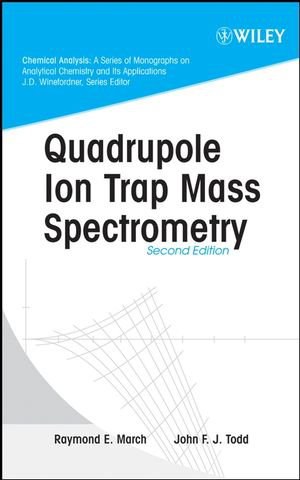
Quadrupole Ion Trap Mass Spectrometry
内容简介
A definitive reference, completely updated
Published in 1989, the First Edition of this book, originally entitled Quadrupole Storage Mass Spectrometry, quickly became the definitive reference in analytical laboratories worldwide. Revised to reflect scientific and technological advances and new applications in the field, the Second Edition includes new chapters covering:
* New ion trap instruments of high sensitivity
* Peptide analysis by liquid chromatography/ion trap tandem mass spectrometry
* Analytical aspects of ion trap mass spectrometry combined with gas chromatography
* Simulation of ion trajectories in the ion trap
One additional chapter discusses the Rosetta mission, a "comet chaser" that was sent on a ten-year journey in 2004 to study the comet Churyumov-Gerasimenko using, among other instruments, a GC/MS system incorporating a specially designed ion trap mass spectrometer.
This comprehensive reference also includes discussions of the history of the quadrupole ion trap, the theory of quadrupole mass spectrometry, the dynamics of ion-trapping chemistry in the quadrupole ion trap, the cylindrical ion trap, miniature traps, and linear ion traps. Complete with conclusions and references, this primer effectively encapsulates the body of knowledge on quadrupole ion trap mass spectrometry.
With its concise descriptions of the theory of ion motion and the principles of operation,
Quadrupole Ion Trap Mass Spectrometry, Second Edition is ideal for new users of quadrupole devices, as well as for scientists, researchers, and graduate and post-doctoral students working in analytical laboratories.
作者简介
March is the third month of the year in both the Julian and Gregorian calendars. Its length is 31 days. In the Northern Hemisphere, the meteorological beginning of spring occurs on the first day of March. The March equinox on the 20 or 21 marks the astronomical beginning of spring in the Northern Hemisphere and the beginning of autumn in the Southern Hemisphere, where September is the seasonal equivalent of the Northern Hemisphere's March. == History == The name of March comes from Martius, the
点击查看全部下载链接(含网盘地址及提取码)